GPT Image 2 Is Rolling Out Right Now: What's Changed, What Still Breaks
By AI Workflows Team · April 21, 2026 · 14 min read
GPT Image 2 entering rollout to paid ChatGPT users. 99% text accuracy, 70% photorealism pass rate, 3-second generation. What changed, what still breaks, vs Midjourney and Nano Banana Pro.
GPT Image 2 Is Rolling Out Right Now: What's Actually Changed, What Still Breaks
TL;DR: As of April 19, 2026, OpenAI has begun a staggered rollout of GPT Image 2 to paid ChatGPT users — no official announcement, just users noticing dramatically better outputs. The model previously leaked as the "tape variants" (maskingtape-alpha, gaffertape-alpha, packingtape-alpha) on LM Arena in early April. Key upgrades: near-perfect text rendering (~99%), photorealism so good 70% of testers can't distinguish it from real photos, 16:9 aspect ratio support, and sub-3-second generation speeds. Still breaks on reflective surfaces like Rubik's cubes. The bigger story: as quality approaches photographic realism, the deepfake and misinformation risks compound fast.
Is GPT Image 2 Actually Out? {#release-status}
Short answer: yes, for some users — no official announcement yet.
On April 19, 2026, reports began surfacing across X (Twitter) and Reddit from paid ChatGPT Plus and Pro subscribers noticing dramatically higher-quality outputs without any change in the interface. No banner, no release note, no blog post. OpenAI's silent staggered rollout style, applied to what appears to be their most capable image model to date.
The model's unofficial public debut came two weeks earlier. On April 4, 2026, three anonymous test variants appeared on LM Arena under the codenames maskingtape-alpha, gaffertape-alpha, and packingtape-alpha — promptly removed within hours, but not before arena testers noticed outputs that made GPT Image 1.5 look like a prior generation. The spread was immediate: arena testers spotted unusual outputs first, then major AI voices on X amplified the screenshots, which exploded across Reddit, YouTube, and TikTok within 24 hours.
One tester's reaction captured the moment: "GPT Image 2 is actually mind blowing, WTF."
OpenAI has not confirmed the model name, pricing, or API availability. Based on their historical release cadence (2–4 weeks from LM Arena testing to public launch), and the DALL-E retirement deadline of May 12, 2026, a full release before that date is the most likely scenario.
How We Got Here: The Image Generation Timeline {#timeline}
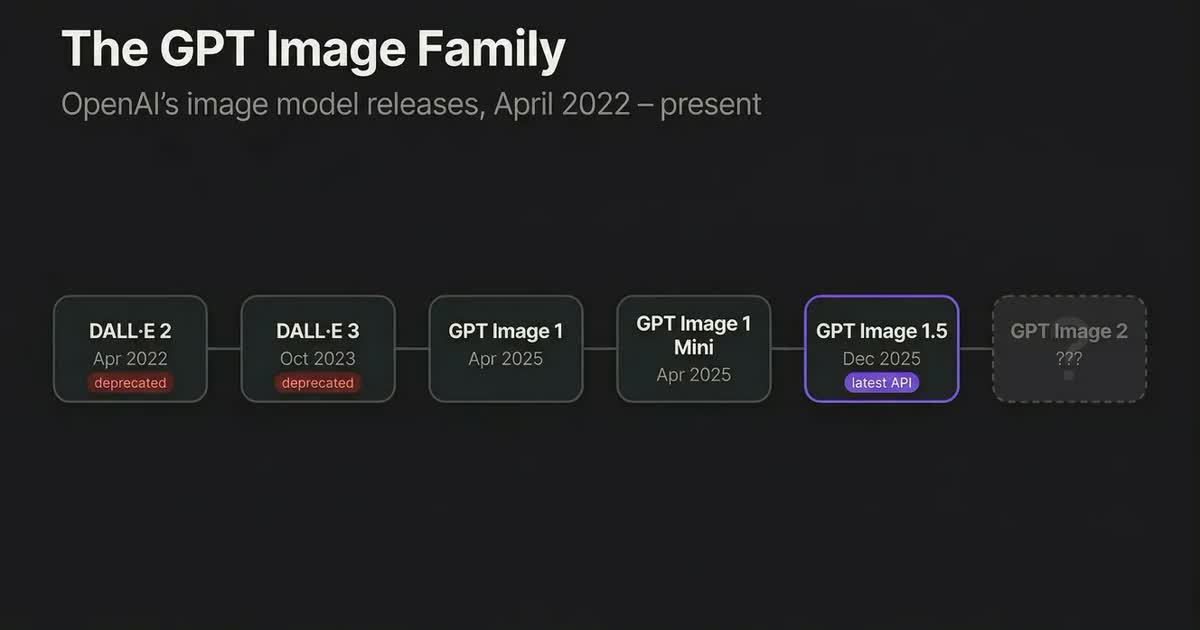
To understand why GPT Image 2 matters, it helps to understand what OpenAI has been building:
| Date | Model | Key Milestone |
|---|---|---|
| March 25, 2025 | GPT Image 1 | First natively multimodal image model; replaced DALL-E 3; 700M images in first week |
| October 2025 | GPT Image 1 Mini | 80% cheaper; optimized for volume |
| December 16, 2025 | GPT Image 1.5 | 4× faster; fixed warm color bias; 20% cheaper API |
| November 2025 | DALL-E 3 deprecated | Removed from API |
| April 4, 2026 | "Tape models" leak | Three variants briefly appear on LM Arena |
| April 19, 2026 | GPT Image 2 rollout begins | Staggered deployment to Plus/Pro users |
| May 12, 2026 | DALL-E sunset | Scheduled retirement of legacy DALL-E endpoints |
GPT Image 1 made the architectural leap from diffusion to autoregressive generation. GPT Image 2 appears to be a further leap — switching from the two-stage pipeline built on GPT-4o to a single-pass standalone model, which explains both the speed gains and the quality jump.
What GPT Image 2 Gets Dramatically Right {#what-works}
1. Text Rendering That Finally Crosses the Line
The single most significant improvement. GPT Image 1.5 achieved approximately 90–95% text-rendering accuracy in English — a major step forward from DALL-E 3's garbled output, but still prone to errors in longer strings, small font sizes, and complex layouts.
GPT Image 2 benchmarks at ~99% text accuracy. According to arena testers, this includes:
- UI mockups with correctly placed button labels and header text
- Street signs with coherent multi-word phrases
- Comic book speech bubbles with readable dialogue
- Handwritten medical notes with convincing penmanship
- Long product label text without character substitution
The practical significance: for the first time, generated images can include accurate, reliable text without manual editing. This is a genuine threshold crossing, not an incremental improvement.
Blind comparison test from LM Arena showing GPT Image 2 performance against competing models. Source: getimg.ai
2. Photorealism That Fools Real People
The warm yellow color cast that plagued GPT Image 1 (and was only partially fixed in 1.5) is eliminated in GPT Image 2. According to testing data from apiyi.com's analysis of the tape model tests, blind test participants mistook GPT Image 2 outputs for real photographs over 70% of the time.
Specific scenes tested and passed:
- Beach photos with multiple subjects, accurate hand anatomy, realistic sunglass reflections
- Complex indoor scenes with consistent lighting across surfaces
- Portraits with skin textures described as "color reproduction now at a level indistinguishable from real photography"
In the LM Arena blind comparisons, GPT Image 2 achieved a 65% win rate over Nano Banana Pro (Google's current leading image model) in photorealism — noteworthy because Nano Banana Pro held the top Arena ranking as recently as March 2026.
3. World Knowledge That Goes Surprisingly Deep
This is the capability that produced the most striking demonstrations. GPT Image 2 can render specific real-world objects, interfaces, and environments with architectural accuracy:
- IKEA storefronts rendered with correct signage, building proportions, and parking lot layouts
- YouTube and Windows interfaces reproduced closely enough to pass as real screenshots
- Minecraft scenes with correct in-game UI, art style, and inventory systems
- Branded environments with accurate logos, color schemes, and spatial layouts
The world knowledge integration is described as "unprecedented detail recognition" — the model doesn't just approximate; it applies specific knowledge of how real things look.
4. The Minecraft Moment That Went Viral
One example crystallized GPT Image 2's world knowledge capabilities and simultaneously raised the loudest alarms. A tester generated a fabricated "Claude Opus 5 Internal Document" embedded within a Minecraft scene — a fake confidential-looking document rendered accurately inside Minecraft's visual style, with readable text.
The image accumulated over 439,000 views and sparked immediate discussion about AI-generated misinformation. The concern: it's not just "this image looks real," it's "this image contains believable fake institutional content embedded in a recognizable context." The combination of world knowledge (Minecraft's visual language), text rendering accuracy, and photorealism creates a new category of credible-seeming fabrication.
5. New Aspect Ratios and Speed
16:9 widescreen support is confirmed as a new addition — the only aspect ratio missing from GPT Image 1.5's 1:1, 3:2, and 2:3 options. This is significant for creators building video thumbnails, presentation slides, and social headers.
Generation speed: The architectural shift from two-stage to single-pass inference is expected to bring typical generation times from 8–12 seconds down to under 3 seconds — a 3–4× improvement that substantially changes the feel of real-time creative iteration.
What GPT Image 2 Still Gets Wrong {#what-fails}
The Rubik's Cube Problem
Arena testers specifically documented that the tape model variants still fail on Rubik's cube reflection tests — a benchmark that requires accurate 3D spatial reasoning combined with realistic reflective surface rendering. This matters because it's a proxy for a broader class of failures: complex geometric accuracy, specular highlights on curved surfaces, and precise multi-element spatial positioning.
Other persistent challenge areas (extrapolated from GPT Image 1.5 patterns and early testing):
- Precise object counting in complex scenes
- Consistent character appearance across multiple generated frames
- Rendering of translucent or transparent materials
The Unknown Post-Launch Edge Cases
The model hasn't had a full public launch yet. Every previous OpenAI image model has revealed new failure modes after scale testing with 130M+ users that weren't visible in controlled arena comparisons. Expect unknown weaknesses to surface post-launch.
The Safety and Moderation Calibration
OpenAI's image models have historically launched with imprecise safety calibration — and better photorealism makes this more consequential. GPT Image 1 simultaneously became too permissive (public figure imagery, deepfake-adjacent content) and too restrictive (blocking legitimate creative prompts). GPT Image 2's dramatically improved photorealism raises the stakes on both sides.
GPT Image 2 vs The Field: Where Does It Actually Stand? {#comparison}
The AI image generation market in April 2026 is more competitive than it's ever been:
| Model | Text Rendering | Photorealism | Speed | API | Artistic Quality |
|---|---|---|---|---|---|
| GPT Image 2 | ~99% ⭐ | Excellent | ~3 sec | Coming soon | Very Good |
| Nano Banana Pro (Google) | Good | Excellent | Moderate | Yes | Very Good |
| Midjourney V8 | Poor | Excellent | 4–20 sec | No | Best in class |
| Flux 2 Pro | Poor | Very Good | Fast | Yes | Very Good |
| GPT Image 1.5 | ~92% | Good | 10–30 sec | Yes | Good |
GPT Image 2 dominates on text rendering — by a wide margin. No other major commercial model is close to 99% accuracy.
Midjourney V8 still leads on artistic aesthetics. For concept art, cinematic scenes, and illustrative work where visual beauty matters more than factual precision, Midjourney remains the professional standard.
Flux 2 Pro (from Black Forest Labs) is the strongest open-weight alternative — strong photorealism at ~$0.03/image with no API restrictions. For developers who need open-source control or can't use OpenAI's API, Stable Diffusion's ecosystem remains the right path.
ChatGPT Plus/Pro subscribers get GPT Image 2 included — the most accessible entry point if you're already paying for ChatGPT.
The Deepfake Problem Gets Harder {#deepfakes}
The same improvements that make GPT Image 2 useful for legitimate creative work also make it more dangerous for misinformation.
70% photorealism pass rate: When most people shown an image can't tell it's AI-generated, the implicit "this is clearly AI" warning that helped audiences calibrate to earlier models disappears.
Accurate UI and interface rendering: GPT Image 2 can generate what appears to be a real screenshot — of an app, a document, a news headline, a financial dashboard. This is a meaningful shift from generating "something that looks like a screenshot" to generating "something that passes as a screenshot."
Real-world precedent: CBC News was able to generate a realistic-looking fake image of a Canadian political figure at a staged event. A Deloitte survey found 59% of users familiar with generative AI have difficulty distinguishing AI-generated media from human-made content — and that was before GPT Image 2's photorealism improvements.
The viral Minecraft/Claude Opus 5 document example wasn't just technically impressive — it was a demonstration of a new class of credible-seeming fabrication: fake institutional content embedded in recognizable visual contexts.
OpenAI embeds C2PA provenance metadata in all GPT Image outputs, but C2PA is invisible to the average social media user and is routinely stripped by platforms during image compression. The detection infrastructure hasn't kept pace with the generation quality.
Pricing Expectations for GPT Image 2 {#pricing}
No official pricing has been confirmed. Based on GPT Image 1.5 pricing and typical OpenAI upgrade patterns:
| Tier | GPT Image 1.5 (current) | GPT Image 2 (estimated) |
|---|---|---|
| Low quality | $0.01/image | ~$0.04/image |
| Medium quality | $0.04/image | ~$0.08/image |
| High quality | $0.17/image | ~$0.17–0.20/image |
| ChatGPT Plus | Included | Included |
The architectural shift to single-pass inference may actually reduce compute costs despite quality improvements — but OpenAI's API pricing decisions don't always track with their infrastructure costs. Pricing will be confirmed on or before the official API launch.
Who Should Actually Be Watching This Rollout? {#who-cares}
Product teams and developers building applications that include generated graphics, marketing assets, or documentation screenshots. GPT Image 2's API (when available) will likely replace GPT Image 1.5 as the default choice for text-accurate generated imagery.
Marketing and content teams who need reliable text-in-image generation without manual editing passes. The jump from 92% to 99% text accuracy is the difference between "use with caution" and "use as primary output."
Designers using ChatGPT — the improved photorealism and 16:9 support expand the range of directly usable outputs for presentation decks, social assets, and concept visualization.
Journalists and fact-checkers — not as users, but as a heads-up. The documentation screenshot problem is real. Standard practice of "check the source" needs to extend to "verify this isn't a generated screenshot."
Midjourney users who don't need API access and prioritize artistic quality — this rollout doesn't change your calculus. GPT Image 2 still doesn't match Midjourney V8 for aesthetic output.
Stable Diffusion users who need open-source control or data privacy — again, not your model. The open-weight ecosystem advantage remains.
Frequently Asked Questions {#faq}
Is GPT Image 2 officially released?
As of April 21, 2026, GPT Image 2 is in a staggered rollout to paid ChatGPT Plus and Pro users but has not been officially announced by OpenAI. An API release is expected alongside or shortly after the public announcement, likely before the May 12, 2026 DALL-E retirement date.
What are the codenames maskingtape-alpha, gaffertape-alpha, and packingtape-alpha?
These were the anonymous test variants OpenAI used to stress-test GPT Image 2 on LM Arena on April 4, 2026. They appeared briefly, performed significantly better than existing models in blind comparisons, and were removed within hours. The community identified them as likely GPT Image 2 variants based on the output quality.
How is GPT Image 2 different from GPT Image 1.5?
The key differences: ~99% text rendering accuracy (vs 90–95%), photorealism that 70% of testers mistake for real photos, 16:9 aspect ratio support, ~3-second generation speed (vs 10–30 seconds), and a new standalone model architecture replacing the GPT-4o pipeline. The warm color bias from GPT Image 1 is fully eliminated.
When will GPT Image 2 be available via API?
No confirmed date. OpenAI typically releases API access alongside or shortly after the public ChatGPT rollout. Given the DALL-E API shutdown on May 12, 2026, GPT Image 2 API access is expected before that date.
Does GPT Image 2 watermark images?
All GPT Image outputs embed C2PA provenance metadata for AI attribution. There's no confirmed change to the watermarking policy between GPT Image 1.5 and 2. The C2PA metadata is invisible in normal use and is often stripped by social platforms during compression.
How does GPT Image 2 compare to Midjourney for creative work?
GPT Image 2 leads decisively on text rendering, photorealism for real-world scenes, world knowledge accuracy, and API integration. Midjourney V8 still leads on artistic aesthetics, cinematic composition, and illustration quality for creative/artistic work. They serve different primary use cases.
Verdict: The Gap Just Closed Significantly — With New Risks {#verdict}
GPT Image 2 isn't just better — it crosses thresholds. Text rendering at 99% accuracy is functionally reliable for production use. Photorealism that 70% of humans can't detect has implications beyond image quality. World knowledge deep enough to render accurate IKEA storefronts and software interfaces is a different category of capability than "impressive-looking generated image."
The positive use cases are obvious and real: marketing teams getting reliable text-in-image outputs, developers building document generation pipelines, designers iterating on concepts at 3-second generation speed.
The risks are equally obvious and real: the same capabilities that make GPT Image 2 useful for legitimate documentation make it capable of producing believable fake screenshots, fabricated institutional documents, and photorealistic deepfake scenarios at scale.
The architecture race between OpenAI, Google (Nano Banana Pro), and Midjourney is now a genuine three-way competition at the capability frontier. What OpenAI has in GPT Image 2 that neither competitor has matched: the combination of text rendering accuracy, world knowledge depth, and ChatGPT integration at this quality level.
The Midjourney advantage in artistic aesthetics remains real. The Stable Diffusion and Flux 2 advantage in open-weight access and customization remains real. But for precision-first, text-heavy, or factual-scene use cases, GPT Image 2 is now the clear leader — and it's just starting to roll out.
Sources & References
- OpenAI: GPT Image 1.5 Model Documentation
- AI Market Watch: OpenAI begins deployment of GPT-Image-2 to ChatGPT users
- Apiyi.com: GPT-Image-2 status update 2026-04-17 — 5 major capabilities exposed
- Frontierbeat: GPT-Image-2 Leaked — Here's What We Know
- Felloai: GPT Image 2 Just Leaked — Everything We Know
- getimg.ai: GPT Image 2 Rumours, Leaks & Release Date 2026
- Nerdbot: GPT Image 2 Is Already Leaking
- MindStudio: What Is GPT Image 2?
- CBC News: ChatGPT now lets users create fake images of politicians
- Wikipedia: GPT Image