GPT-6 Astra vs Claude Fable 5.1: Why Cost Benchmarks Disagree
By AI Workflows Team · September 11, 2026 · 10 min read
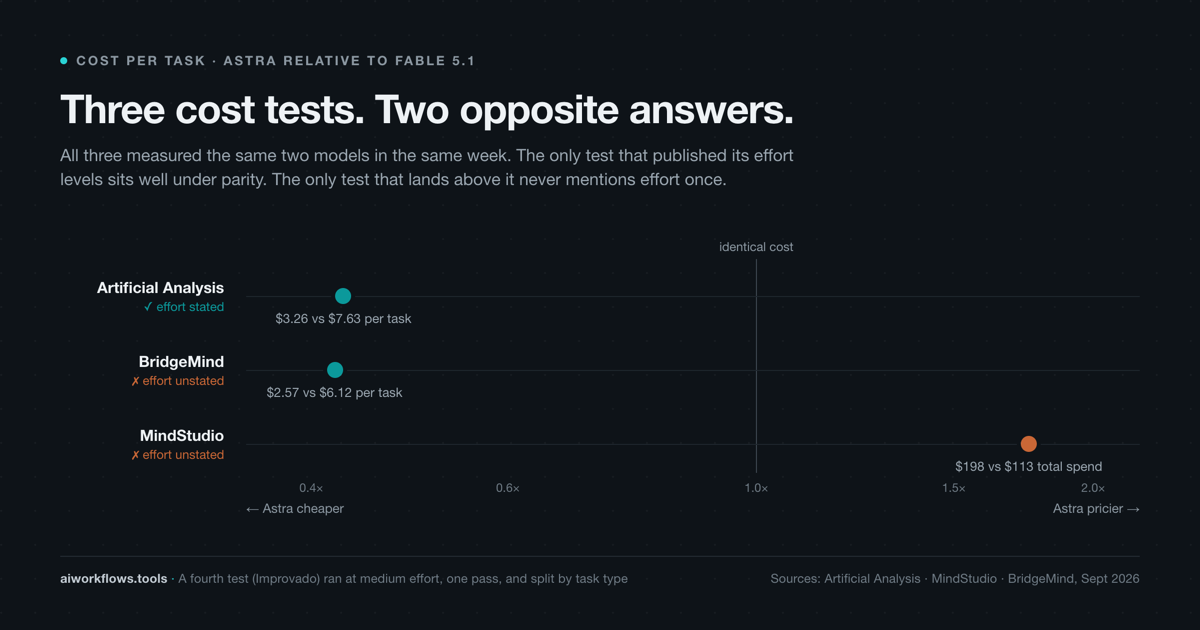
Both models list at $10/$50 per million tokens, yet published tests put GPT-6 Astra anywhere from 60% cheaper to 75% pricier than Claude Fable 5.1. Three variables explain the spread: the reasoning effort dial, token efficiency, and a safeguard fallback that scores Fable 5.1 a zero on tasks it declines.
GPT-6 Astra vs Claude Fable 5.1: Why Cost Benchmarks Disagree
TL;DR: Both models list at exactly $10 per million input tokens and $50 per million output. Published cost comparisons still put Astra anywhere from 60% cheaper to 75% more expensive than Claude Fable 5.1. Nobody is lying. The tests measured different things, and three variables explain almost all of the spread: the reasoning effort level, how many tokens each model burns to finish a task, and a safeguard fallback that scores Fable 5.1 a zero on tasks it declines. On Artificial Analysis's own numbers, moving Astra from low effort to max effort takes cost per task from $0.82 to $3.26 — a 4x swing inside a single model.
OpenAI shipped GPT-6 Astra on September 3, 2026, and it reached ChatGPT and Codex the same day. Anthropic had shipped Claude Fable 5.1 two days earlier, on September 1, where it sits at the top of Claude and Claude Code. Same price per token, near-identical context windows, identical max output, and both aimed at the same autonomous agent workflows. Then the benchmarks landed, and they landed in opposite directions.
Four public sources, same pair of models, same week:
| Source | Verdict | The numbers | Effort level stated? |
|---|---|---|---|
| Artificial Analysis | Astra ~60% cheaper | $3.26 vs $7.63 per task | Yes — "max effort", Fable 5.1 as "max with fallback" |
| MindStudio | Astra 75% more expensive | $198 vs $113 across a coding suite | No — effort appears zero times |
| BridgeMind | Astra ~58% cheaper | $2.57 vs $6.12 per task | Not stated |
| Improvado (own tests) | Mixed by task type | 4 prompts, OpenRouter | Yes — "effort set to medium", one run per prompt |
Two of them say Astra saves you money. One says it costs 75% more. They ran different tests, at different settings, and reported the results as answers to the same question.
Variable 1: the effort dial moves cost more than the model choice does
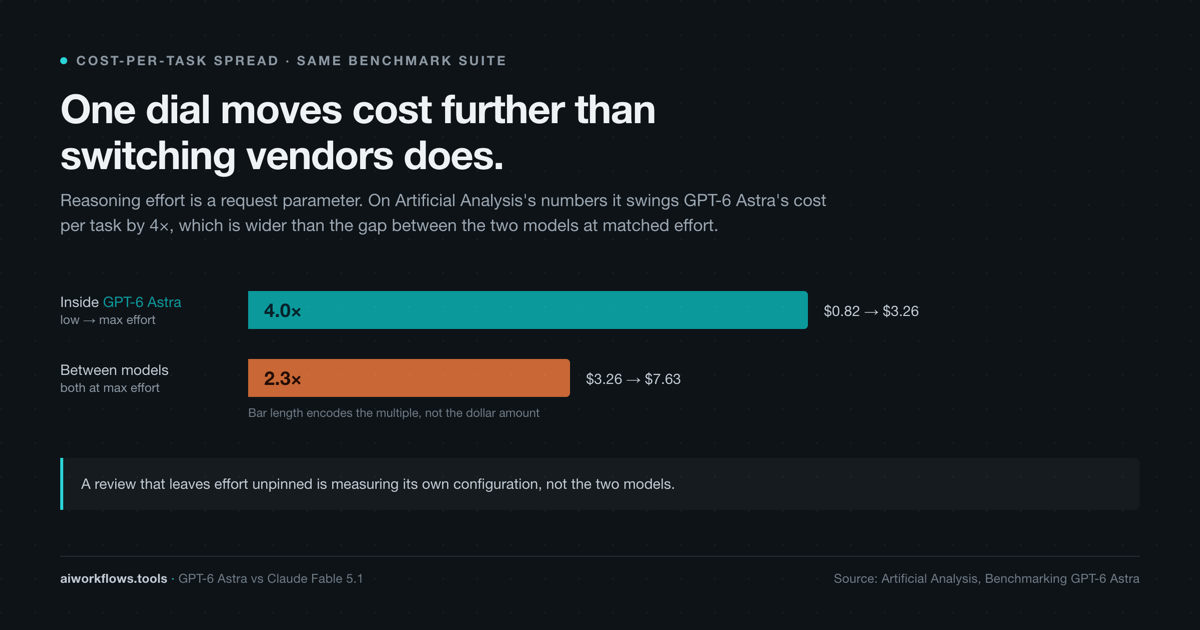
Artificial Analysis published the number that settles this, and it sits in their own writeup rather than in anyone's comparison: every reasoning effort level of GPT-6 Astra lands on the Intelligence Index vs Cost per Task frontier, from low at $0.82 per task to max at $3.26.
One model. One benchmark suite. A 4x cost range, controlled by a parameter you set in the request.
Now put that spread next to the gap everyone is arguing about. Artificial Analysis has Astra at $3.26 against Fable 5.1's $7.63, a 2.3x difference between models. The range inside one model is wider than the gap between two. A test that leaves effort unpinned measures its own configuration more than it measures either model.
That is how MindStudio's $198 vs $113 and Artificial Analysis's $3.26 vs $7.63 can both be true. MindStudio ran eight short KingBench 3 tests plus four long-horizon app builds and reported total token spend. Their writeup mentions reasoning effort zero times. Run Astra at a high setting while Fable 5.1 sits at its default and the totals flip, without either number being wrong.
The defaults are not aligned either:
- Claude Fable 5.1 defaults to
higheffort on the Claude API. Anthropic's release notes add that it "defaults to High effort in Claude Code, and to Medium in Claude Cowork and on Claude.ai." The same model bills differently depending on which surface you sit in. - GPT-6 Astra supports
low,medium,high,xhigh, andmax. It does not supportnone, which GPT-5.6 does. No no-reasoning mode, no floor belowlow.
A reviewer who leaves both on defaults is comparing Claude Code's High against whatever their Astra client picked. The headline says the models were compared. The test compared two config files.
Anthropic makes the same point from the other direction in its announcement: set to Low or Medium effort, Fable 5.1 "achieves results similar to or better than Fable 5's at a much lower cost."
Variable 2: token efficiency, which nobody names
Both models charge the same per token. $10 in, $50 out, identical to the cent. When cost per task differs by 2.3x, none of that difference comes from price. All of it comes from how many tokens each model burns to finish the job.
Artificial Analysis measured it. At max effort, Astra uses about 27,000 output tokens per task. Claude Fable 5.1, at max with fallback, uses about 78,000. Close to 3x more tokens for the same work.
Agent turns show the same shape. On GDPval, which spans 44 occupations, Artificial Analysis counted 24 turns per task for Astra at max effort, against 45 for GPT-5.6 Sol and 60 each for Fable 5.1 and Claude Opus 5.
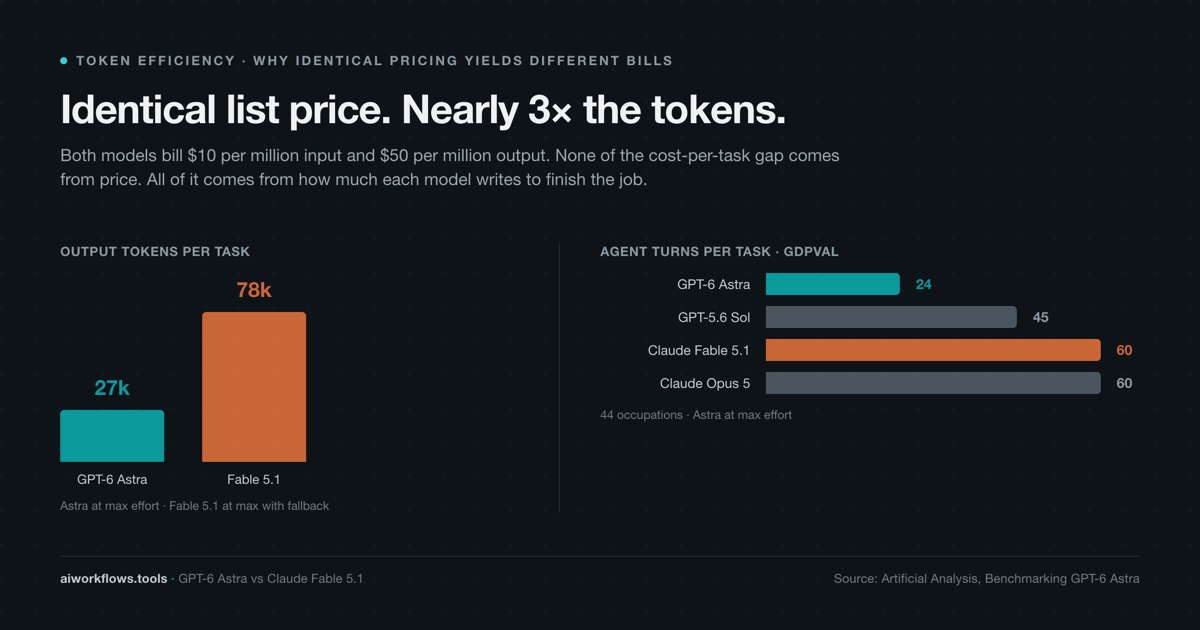
So "which is cheaper" has nothing to do with the price sheet. The real question is which model finishes your specific task in fewer tokens, at the lowest effort setting that still clears your quality bar. That depends on your workload, which is exactly why generic per-task comparisons keep contradicting each other.
Anthropic did cut real costs, through a lever the benchmarks mostly miss: cache reads. Fable 5.1 reads cached input at 2.5% of base input price, against the 10% that applies to other Claude models. Anthropic estimates roughly 25% lower cost than Fable 5 for typical workloads, "up to approximately 45%" for highly agentic work. That discount only appears if your prompts hit the cache, which means long stable system prompts and repeated context. A benchmark firing fresh prompts every run captures none of it.
Variable 3: Fable 5.1 scores zero on tasks it refuses
This one comes from Anthropic, in a footnote under its own benchmark table, and I have not found it in a single comparison article:
"Fable 5.1 was evaluated with its production safeguards enabled. On tasks where these safeguards intervened, Fable 5.1 and Fable 5 scored a zero on OSWorld 2.0, and Fable 5 scored a zero on AutomationBench. In all other interventions from our safeguards, cybersecurity tasks were completed by Claude Opus 4.8, and biology tasks were completed by Claude Opus 5. This likely reduces the performance of Fable 5.1 and Fable 5 on these benchmarks."
Read that again. Anthropic published scores for its own flagship that include a penalty its flagship takes for declining work. On some tasks the model gets a zero. On others, a different model finished the job and the score still sits in Fable 5.1's column.
This is what Artificial Analysis means by "(max with fallback)" every time it names Fable 5.1. The fallback is the safeguard handoff.
So when a comparison puts Fable 5.1's number next to Astra's, it compares a score carrying a refusal penalty against a score that carries no disclosed equivalent. Whether Astra has a similar mechanism is unknown, because OpenAI published no benchmark numbers for Astra at all.
Anthropic also shipped a fix for the same problem in the same release: the newest safeguards block 60% fewer false positives than before, and Fable 5.1 can now find software vulnerabilities, though not write exploits for them. Mythos 5.1 is the same underlying model with those safeguards lifted, available only to Project Glasswing participants. The gap between the Fable and Mythos columns in Anthropic's chart is the cost of the safeguards, stated in points.
What the spec sheets say
Stripped of benchmarks, the two are closer than the discourse suggests.
| GPT-6 Astra | Claude Fable 5.1 | |
|---|---|---|
| Released | September 3, 2026 | September 1, 2026 |
| Model ID | gpt-6-astra |
claude-fable-5-1 |
| Input / output price | $10 / $50 per MTok | $10 / $50 per MTok |
| Cache reads | 90% discount, 25% premium on writes | 2.5% of base input price |
| Context window | 1.05M | 1M |
| Max output | 128K | 128K |
| Reasoning effort | low → max, no none |
adaptive, always on; default high |
| Knowledge cutoff | April 30, 2026 | June 2026 |
| Retirement commitment | Not published | Not sooner than September 1, 2027 |
Two asymmetries worth flagging. Anthropic commits to a retirement date; OpenAI publishes none for Astra. And Anthropic shipped a full benchmark table at launch, including a column for GPT-5.6 Sol, while OpenAI's developer documentation carries no Astra scores at all. Every Astra number in circulation comes from a third party.
Timing made one gap unavoidable. Anthropic built its comparison table on September 1, when GPT-6 Astra did not exist. The only first-party table comparing these families head to head structurally cannot include the model everyone is asking about.
Where each one actually wins
On Anthropic's published figures, Fable 5.1 is a jump over its predecessor rather than a refresh:
| Benchmark | Fable 5.1 | Fable 5 | Opus 5 | GPT-5.6 Sol |
|---|---|---|---|---|
| Terminal-Bench-Science 0.1 | 52.6% | 24.7% | 29.0% | 22.4% |
| GDPval-AA v2 (knowledge work) | 1853 | 1723 | 1824 | 1711 |
| OSWorld 2.0 (partial) | 77.9% | 72.9% | 75.4% | — |
| OSWorld 2.0 (strict) | 41.7% | 36.1% | 39.6% | — |
| CursorBench 3.2.0 | 73.4% | 70.5% | 70.0% | 67.2% |
Note the column that is missing. Read this as "Fable 5.1 against the field as of September 1," not as a verdict on Astra. And remember the OSWorld rows carry the safeguard penalty described above.
Anthropic's early-access partners were more specific than the table. Craig Falls, Head of Quantitative Research at Jane Street Capital, reported that Fable 5.1 "solves more of our coding problems than Fable 5 or Opus 5" and stays readable across long multi-step tasks, where earlier models became hard to follow. Cognition co-founder and CPO Walden Yan said they moved Devin's Opus 5 traffic to Fable 5.1 on launch day, crediting the cache read pricing for finally making a Fable-class model economical for code review. Another partner measured 82% task completion on their hardest browser-agent benchmark, against 74% for Opus 5 and 57% for Fable 5.
Astra's evidence is thinner and all external. Artificial Analysis found its hallucination rate dropping from 92% to 51% at max effort on their knowledge benchmark, without the accuracy tradeoff that usually accompanies that kind of gain. OpenAI's developer blog has published application walkthroughs instead of scores: driving Blender and Unreal Engine 5 for architectural visualization, and building a procedural space exploration game inside Codex.
Migration constraints nobody put in a comparison table
If you are switching, the API differences will cost more of your week than the benchmark deltas will. These come from the two vendors' docs. None of the comparison articles mention them.
Moving to GPT-6 Astra:
- No
nonereasoning effort. Code that sets it needs a new floor. - No custom
temperature,top_p, orlogprobs. An eval harness pinning temperature to 0 for reproducibility loses that lever. - Tool calling requires the Responses API. Chat Completions with tools needs migrating first.
- Not available for Codex cloud tasks. Astra runs in the ChatGPT desktop app, ChatGPT web, the Codex CLI and the IDE extension. Cloud is the one exception.
Moving to Claude Fable 5.1:
- Forced tool use is not supported.
tool_choice: {"type": "any"}or{"type": "tool", ...}returns a 400. Anthropic's guidance is to keepautoand say in the prompt when the tool applies. - Thinking blocks bind to the model that produced them, and compatibility runs one way. Fable 5.1 reads earlier models' thinking; no earlier model reads Fable 5.1's. A router that falls back mid-conversation drops the reasoning, silently unless you opt into the beta header that reports it.
- Editing an earlier turn invalidates every later thinking block. Anthropic enforces this for accounts created on or after August 31, 2026; older accounts record the mismatch without acting on it. Anything that rebuilds the system prompt or tools array between requests in one conversation will trip it.
How to read any cost claim about these two
Six questions, ordered by how often they go unanswered:
- What effort level did each model run at? Unstated means the number describes the reviewer's defaults.
- Were the effort levels comparable? Astra's max against Fable 5.1's default is not a fair fight in either direction.
- Cost per task, or total spend? Total spend across a fixed suite rewards whichever model that suite happens to suit.
- Did the prompts hit the cache? Fable 5.1's headline savings live almost entirely in cache reads.
- Do the scores carry a safeguard penalty? Anthropic says its own do. "With fallback" in a column header is the tell.
- How many runs per prompt? Improvado's comparison, one of the more transparent ones, ran a single pass over four tasks. Useful as a direction, not as a measurement.
So which one should you use?
For long-horizon agentic coding where the conversation stays stable and context gets reused, Fable 5.1's cache read pricing is a structural advantage that per-task benchmarks under-report. Anthropic's own default recommendation still sends most workloads to Claude Opus 5 first, reserving Fable 5.1 for work where Opus 5 at higher effort falls short. That is a more conservative pitch than vendors usually make about a flagship.
For work where token efficiency dominates — many short tasks against tight per-task budgets — Astra's 27k output tokens against Fable 5.1's 78k is the number that matters, and it holds on turn count too.
If you already live in ChatGPT or Codex, Astra is there everywhere except Codex cloud. If you live in Claude Code, Fable 5.1 sits at the top of the line and runs at High effort by default, which is worth knowing before your first bill.
When the decision looks close, the cheaper experiment is not a model switch. Drop one effort notch on the model you already run, then measure.
Frequently Asked Questions
Is GPT-6 Astra cheaper than Claude Fable 5.1?
Per token, neither. Both list at $10 input and $50 output per million tokens. Per task, published results disagree because they use different reasoning effort settings. Artificial Analysis measured $3.26 for Astra against $7.63 for Fable 5.1, both at max effort.
Why do GPT-6 Astra cost comparisons contradict each other?
Reasoning effort usually goes unstated. Artificial Analysis found Astra's cost per task ranging from $0.82 at low effort to $3.26 at max, a wider spread than the gap between the two models. Tests that leave effort unpinned measure configuration.
Does GPT-6 Astra support temperature and top_p?
No. GPT-6 Astra rejects custom temperature, top_p, and logprobs values, and it does not support the none reasoning effort level that GPT-5.6 offers. Tool calling requires the Responses API.
Can I use GPT-6 Astra in Codex cloud?
No. Astra runs in the ChatGPT desktop app, ChatGPT web, the Codex CLI, and the Codex IDE extension. Codex cloud tasks are the exception.
What changed between Claude Fable 5 and Fable 5.1?
Token prices held, with cache reads cut to 2.5% of base input price. Anthropic estimates roughly 25% lower cost for typical workloads and up to about 45% for highly agentic work, plus stronger long-running agentic coding and 60% fewer cybersecurity false positives.
Sources
- Anthropic, "Claude Fable 5.1 and Claude Mythos 5.1" announcement (September 1, 2026)
- Anthropic, Claude API model overview and Fable 5.1 release notes
- OpenAI, developer changelog entry for GPT-6 Astra (September 3, 2026) and API model reference
- OpenAI, ChatGPT and Codex model documentation (surface availability)
- Artificial Analysis, "Benchmarking GPT-6 Astra"
- MindStudio, "GPT-6 Astra vs Fable 5.1: What They Actually Cost to Run"
- Improvado, "GPT-6 Astra vs Claude Fable 5.1: Which AI Should You Use?"